One of the most rapidly developing forms of the American football is flag football. As opposed to the conventional tackle football, the game is not about physical contact but speed, teamwork, and strategy. Due to this fact the rules of flag football prove to provide a safer atmosphere and yet provide an exciting and competitive game.
This form of football has become the favorite of many youth leagues, schools and recreational groups. The game enables players with varying degrees of skills to join and get to learn the basics of the game without the possibility of heavy collisions. Consequently, novices and advanced players have fun mastering the flag football rules and then going out to the field.
Besides, these rules make the traditional format of football easier though retaining the strategy and excitement preferred by fans. The game is quicker, the chances to score more, and all the players are engaged in each play.
This comprehensive guide will teach you the basics of the rules of playing flag football, how to play the game and discuss some of the most important terms, positions and equipment that are required to play the game.
What Are the Basic Flag Football Rules?
The greatest concept of the rules in the game of flag football is that the game does not involve physical tackling. Defenders prevent the pass by pulling a flag to the belt of a ball carrier instead of throwing him to the ground.
The players have a belt on which there are two flags on the sides. As the defense takes away a flag, the play is immediately terminated. Due to this system, the game remains quick, safe and can be played by players of various ages.
Secondly, there are some fundamental rules that determine the manner in which the game is played. These rules of flag football are fair and promote passing, teamwork and strategy.
Key Game Rules
- First, any forward pass has to go beyond the line of scrimmage and then a receiver has to catch the pass.
- Second, a player can make handoffs and backwards pitches offside.
- But after the ball passes over the line of scrimmage no backward pass and handoff is allowed.
- The quarterback should also be able to pass the ball in seven seconds of its delivery by the snapper.
- After a handoff, or lateral, the seven-second limit is no longer applicable.
- Also, the quarterback is not allowed to run past the line of scrimmage with the ball.
- Attacking players should not block or hinder defenders.
- There can be a maximum of two rushers on the designated rush line who can rush the quarterback.
- Any defender may cross over the line of scrimmage when passing on the ball.
- During normal plays, interceptions can be returned to result in a TD.
Such rules of flag football make sure that the game focuses on skill, speed, and intelligent passing.
NFL Style Flag Football Rules and Game Setup
NFL FLAG leagues have many youth leagues that are organized in a similar format. These leagues have simplified flag football rules that are safe and fair.
Competitions typically involve 5-on-5, though other game sizes like 6-on-6 or 7-on-7 are used in various age groups and according to local regulations.
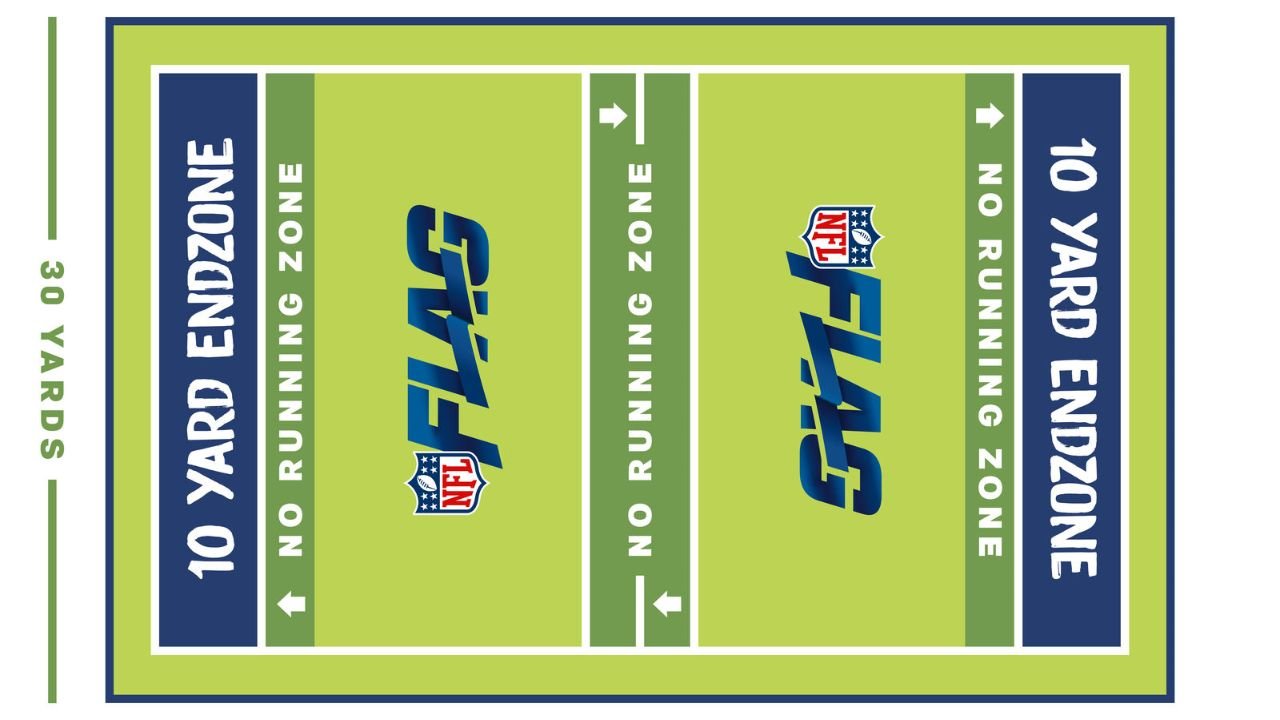
The playing field is reduced in size compared to a normal football field since there are fewer players on the field.
Typical Field Dimensions
| Field Element | Measurement |
| Field Length | 70 yards |
| Field Width | 30 yards |
| End Zone Size | 10 yards each |
| Rush Line Distance | 7 yards from line of scrimmage |
| No-Run Zone Distance | 5 yards from goal line |
These dimensions allow the flag football rules to create a quicker, high-scoring version of football.
How a Flag Football Game Begins
Each game begins with a coin toss. The victorious decides to either start with the ball in possession or wait to the second half.
The flag football rules do not have any kickoffs, unlike in the traditional football. Rather, the offensive team starts its line of attack at its five-yard line.
The games are usually played in two halves with the duration of these halves ranging between 15 and 25 minutes, as per league rules. The clock does not stop unless when there are injuries, timeouts or halftime.
A team typically is allowed one time out per half.
The offensive team also has four tries, called downs, in order to make it to midfield. In case they do succeed, they will have three additional downs to get a touchdown.
These flag football rules contribute to the fact that the whole game is played at a high speed.
Scoring in Flag Football
Even though flag football eliminates the aspect of physical tackling, the scoring system is just like in ordinary football.
There are a number of ways that teams get points and the flag football rules are explicit about the various ways of scoring.
Standard Scoring Format
- Touchdown: 6 points
- Extra point (short distance): 1 point
- Extra point (long distance): 2 points
- Safety: 2 points
Due to the speed that the flag football rules bring about, games are usually characterized by the occurrence of many scoring opportunities.
Who Can Play Flag Football?
The accessibility of the sport is one of the greatest benefits of it. Participation does not require a certain body type or previous experience, especially among the players.
Once the rules of flag football are mastered, young athletes, teenagers, and adults can enjoy it.
Several youth leagues cater to players as young as 5 years to 17 years of age and there are many programs that have co-ed teams. Moreover, the sport has become popular among female high school and college athletes.
Due to the lack of hard contact, parents and coaches tend to teach the children the rules of flag football as a non-contact way of learning the basics of football.
7-on-7 Flag Football Rules
Most leagues set up with the conventional five players, however, some competitive organizations have adopted 7-on-7 variation of the game.
In such leagues, the number of players per team is seven rather than five, which alters offensive and defensive tactics a bit.
The basic rules of flag football, however, are largely similar. Passing remains in the center stage and players still depend on flag pulling rather than tackling.
There are competitive leagues which can permit the use of limited blocking or light contact. Due to this difference, players are always advised to consult the rulebook of their particular league.
However, the majority of youth programs continue to play the softer variant of the flag football rules having no-contact regulations.
Important Flag Football Field Terms
Knowing the field layout assists the players to learn the rules of flag football more conveniently.
Some of the common terms in use during games are given below.
- Boundary Lines: The field lines that are the sidelines and end zones.
- Line of Scrimmage: The hypothetical line with which every play starts.
- Line to Gain: The distance that the offense should travel to get a first down.
- End Zone: Scoring zone at each end of the field.
- Backfield: This is a space behind the line of scrimmage where the offensive players are lined.
- No-Run Zone: A section where teams must pass instead of running the ball.
All these factors collaborate to enable the framework established by the flag football regulations.
Important Game Terms in Flag Football
Players will hear new words when they begin to learn the game. Though, it is much easier to understand the flag football rules when these terms are known.
Key Gameplay Terms
- Dead Ball: This is when the play is brought to a halt. An example is when the flag of the ball carrier is pulled, the player goes out of bounds or the ball touches the ground.
- Down: Down is every offensive effort to advance the ball.
- Flag Guarding: When a ball carrier is standing in the way of a defender taking the flag, the referee blows a penalty.
- Live Ball: The term implies the time when the play is moving.
- Rusher: A defensive player and tries to get to the quarterback.
Knowing these definitions will enable players to comprehend fully the rules of flag football when playing.
Essential Flag Football Equipment
The sport has gained popularity due to minimal equipment needed to play. Players do not require heavy protection equipment as in tackle football.
The following are the minimum equipment required to play the rules of flag football.
- Flag belt with removable flags
- Shorts (sports shorts) without pockets.
- Mouthguard
- Football cleats (non-metal)
- Optional football gloves
The equipment list is kept minimal so that the players could easily begin to learn the rules of flag football and train their abilities.
Flag Football Positions Explained
The structure of flag football removes the traditional offensive line. As a result, each player becomes more involved in the action.
Offensive Positions
A typical offensive formation includes:
- Quarterback
- Center
- Wide receivers or running backs
The center snaps the ball to the quarterback, who either passes the ball or hands it off to a teammate.
Defensive Positions
Defensive players usually fall into two categories:
- Rushers
- Defensive backs
Rushers pressure the quarterback, while defensive backs cover receivers and attempt to pull flags.
These roles allow teams to follow the flag football rules while maintaining exciting offensive and defensive strategies.
Why Flag Football Is Growing So Quickly
The worldwide popularity of flag football is on the rise. This rapid growth can be attributed to a number of reasons.
To begin with, the rules in flag football decrease injuries because they eliminate tackling and heavy contact. Second, the game promotes collaboration and speed of decision-making.
Besides, athletic abilities including speed, coordination and agility are developed through the sport.
Schools and youth programs are more willing to use flag football as it educates the basics of football, and is accessible and inclusive.
Final Thoughts
The flag football is an exciting alternative to the conventional tackle football. The sport is focused on speed, passing and strategy, and it keeps players safe.
Knowing the rules of the flag football, the novicers will be able to learn the principles of this game quickly and begin to have fun. In addition, these regulations provide fairness, teamwork, and make the action fast and exciting.
Also Read More: Best Footballs Like NFL – Top Match-Quality Soccer Balls for Elite Performance